Edinburgh Airport Airspace Change Consultation goes LIVE
The official public consultation for the Airspace Change Proposal (ACP) has begun. This is your opportunity to review the proposed flight path changes and share your views on the future layout of our skies and the resulting noise impact on your community.
The dedicated ACP Consultation Portal serves as the central hub for all information and materials – EDI ACP PORTAL
We urge all residents to engage with the materials, attend a drop-in session if possible, and submit a formal response. Your feedback is vital to ensure the final design appropriately balances operational efficiency with the mitigation of noise impact on our communities – SUBMIT RESPONSE
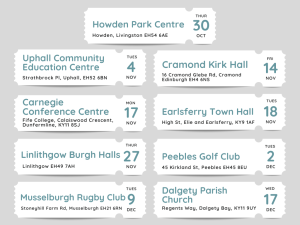
Consultation Timeline and How to Participate
The 14-week public consultation period officially runs from Monday, October 20th. Please note that the period includes a two-week break over the Christmas holidays.
All in-person Drop-In sessions will run from 2:00 PM to 8:00 PM. The current schedule and locations are listed above. Always check the consultation webpage before attending as times and locations are subject to change.
For those unable to attend in person, online Webinars are scheduled as below. Further details on how to join these online sessions will be provided on the events section of the Consultation Portal
| Date | Time |
| Monday, December 8th | 18:00 Connect |
| Tuesday, December 23rd | 15:00 Connect |
| Monday, January 5th | 18:00 Connect |
There are also drop-in events and webinars scheduled for Glasgow Airport and NATS – Scottish Airspace Events
Experience the Impact Virtually
To help you understand the real-world consequences of the proposed changes, Edinburgh Airport is providing several immersive, user-friendly tools:
Virtual Room: A dedicated Virtual Room will be accessible via the consultation website, serving as an online hub for all materials and information – Virtual Room
VOLANS Videos: Videos have been produced using the VOLANS system, visually demonstrating all proposed arrival and departure flight path options:
Soundbox Experience: A feature available both at the physical drop-in sessions and online. Use an interactive map to virtually experience the projected noise levels of over-flights at your specific postcode – Soundbox
Full Materials Available for Review
A comprehensive suite of documents has been prepared to ensure transparency and detailed understanding:
- Core Documents: A user-friendly Consultation Summary Document the main Consultation Document, and the detailed Consultation Strategy
- Technical Details: The Full Options Appraisal provides the technical explanations, detailed routes for each option, and the underlying rationale behind them.
- Evidence Base: All proposals are backed by visual and economic data, including noise contours, over-flight contours, and the WebTAG cost-benefit analysis.
- Frequently asked Questions: A dedicated FAQ Document answering common queries about the ACP process is also available.
For those interested in regulatory documentation, the CAA Edinburgh Airport Airspace Change (FASI) webpage allows you to download all relevant CAP1616 documents for the consultation – CAA Edinburgh Airport Airspace Change
The Scottish Airspace Modernisation initiative is running concurrently with consultations for Glasgow Airport and NATS happening in parallel with Edinburgh Airport’s proposal – Find out more
The ACOG Airspace Change Masterplan Iteration 3 that covers the ScTMA Cluster is available to view – Airspace Change Masterplan
Relevant documents
FAQs
Frequently Asked Questions regarding the ACP and Flight Paths
Yes, ATC provides pilots with instructions regarding take-off and landing procedures, flight paths, altitudes, and other essential information to ensure safe and efficient air traffic management. However, pilots also have a responsibility to adhere to safety regulations and make decisions based on their own judgement and experience.
While Air Traffic Control assigns flight levels to pilots, there can be some flexibility depending on factors such as weather conditions, air traffic, and aircraft performance. Pilots may request changes to their assigned altitudes, but these requests must be approved by ATC to maintain safety and separation from other aircraft.
Flight paths can vary due to several factors, including weather conditions, traffic volume, airspace restrictions, noise abatement procedures, and runway configuration. Pilots and ATC work together to optimise routes while minimising noise impact on communities.